March ends in a couple days and I'm racing to finish this post. Here's a look at things I enjoyed this month!
1) Overnight Dates
Jess and I went to see Audrey Assad and Andrew Peterson in concert as a joint birthday present (but mostly for him present). Getting away and enjoying something together that had nothing to do with ministry was refreshing. The kids stayed with friends and we enjoyed a peaceful and thoughtful concert together...and got some good quiet, uninterrupted reading time.
2) Quality conversations
I'm increasingly more irritated by shoot the wind small talk. Before this year, I would scratch my head when friends would complain about how it would exhaust them...but now, I get it. It just feels like a waste of air compared to some of the amazing, deep conversations you could have instead! Lately my favorite conversations center around cross cultural education and relations, home education, and self-leadership.
3) Dead Mentors
As morbid as it sounds, it is true. I've been discovering a wealth of wisdom in the books I've read by Charlotte Mason (educator from England who lived in the 1800s) and selections from Henri Nouwen's books.
4) Growing Personalities
Clay and Celia continue to grow and their personalities shine ever the brighter. It's fun to hear the little songs Celia will sing, and to try to answer (to find the answer) to Clay's curious questions about nature.
5) Lent
Jess and I decided to participate in Lent this year by giving up movies and shows. It's been nice to read other books, play music, or just talk instead of staring at a screen.
Monday, March 27, 2017

Is Reality Secular? Thoughts from Chapter 1
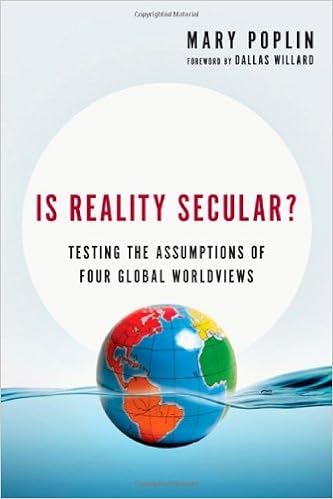
Because I find myself in so many conversations with students that dive into Christian apologetics, Jess put the book Is Reality Secular? into my hands. It's written by Dr. Mary Poplin, a professor from Claremont Graduate University in California. In this book, she aims to explore this question by examining the four global world views: Material Naturalism, Secular Humanism, Pantheism, and Judeo-Christian Theism. Needless to say, it's academically heavy.
In this first chapter, she opens with a story about exploring this question with a class of PhD students. One of them, eager to respond, states, "Setting aside the idea of truth..." In this moment, with some of the brightest students in the nation, Poplin realized that that statement unveiled how secularism has rooted itself in the west. Truth is no longer a reality, but an idea that we can set aside. (This baffled me.)
In this first chapter, she opens with a story about exploring this question with a class of PhD students. One of them, eager to respond, states, "Setting aside the idea of truth..." In this moment, with some of the brightest students in the nation, Poplin realized that that statement unveiled how secularism has rooted itself in the west. Truth is no longer a reality, but an idea that we can set aside. (This baffled me.)
Poplin goes on to describe how secularism has replaced the ideas of Christianity as the main narrative to guide Western society. Secularism, which says that scientific evidence and human reason are all we need as guidance. As logical as it may sound, secular humanism also has its blind spots. I found this quote from William Cavanaugh quite eye opening:
"The myth of religious violence promotes a dichotomy between us and them, the hordes of violent religious fanatics in the Muslim world. Their violence is religious, and therefore irrational and divisive. Our violence, on the other hand, is rational, peacemaking, and necessary. Regrettably, we find ourselves forced to bomb them into higher rationality."
In fact, Poplin goes on to say that the terrorist attacks on 9/11 were not against Christianity, but against the pervasive secular moral and economic systems of the West. It's plain to see if you examine the targets - the World Trade Center towers, the Pentagon, and the White House...not the National Cathedral. Although secular humanism appears neutral, it actually isn't. The truth is that it is actually as emphatic about its doctrines as radical Islam. Neither view will tolerate anything outside of itself.
Interesting enough, many of the uprisings that occur within nation-states come from ideals (egalitarianism, justice, freedom, human rights) that have roots in Christianity. As atheist German philosopher Jurgen Habermas pointed out:
"...Christianity has functioned as more than just a precursor or a catalyst. Universalistic egalitarianism, from which sprang the ideals of freedom and a collective life in solidarity, the autonomous conduct of life and emancipation, the individual morality of conscience, human rights and democracy, is the direct legacy of the Judaic ethic of justice and the Christian ethic of love. This legacy, substantially unchanged, has been the object of a continual critical re-appropriation and reinterpretation. Up to this very day there is no alternative to it. And in light of the current challenges of a post-national constellation, we must draw sustenance now, as in the past, from this substance...Everything else is idle post-modern talk."
In order to see truth as it is, any person must know the thrust of each major world view, as well as the motivations behind their own world view. Failure to do this is actually a failure to see reality as it is presented, whether wholly or a jaded spin, by our friends, the govenment or the media.
I'll end with this quote by Dallas Willard. He encapsulates Poplin's motivation for the book well.
"Is reality secular? Is adequate knowledge secular? And is that something that has been established as a fact by thorough and unbiased inquiry? Is this something that today's secular universities thoroughly and freely discuss in a disciplined way? Certainly not! Nowhere does that happen. It is now simply assumed that every field of knowledge or practice is perfectly complete without any reference to God. It may be logically possible that this assumption is true, but is it true?"
Monday, March 20, 2017
Henri's Prayer
Lately I have been using A Guide to Prayer for Ministers and Other Saints for my time in the scripture. It follows the liturgical calendar, and has appropriate passages for each day, selections from various books other than the Bible, and a weekly hymn. Today's selection included a prayer of Henri Nouwen from his book, Cries for Mercy.
"Every day I see again that only You can teach me to pray, only You can set my heart at rest, only You can let me dwell in Your presence. No book, no idea, no concept or theory will ever bring me close to You unless You Yourself are the one who lets these instruments become the way to you.
"But Lord, let me at least remain open to Your initiative; let me wait patiently and attentively for that hour when You will come and break through all the walls I have erected. Teach me, O Lord, to pray."
Amen, Henri.
"Every day I see again that only You can teach me to pray, only You can set my heart at rest, only You can let me dwell in Your presence. No book, no idea, no concept or theory will ever bring me close to You unless You Yourself are the one who lets these instruments become the way to you.
"But Lord, let me at least remain open to Your initiative; let me wait patiently and attentively for that hour when You will come and break through all the walls I have erected. Teach me, O Lord, to pray."
Amen, Henri.
Subscribe to:
Posts (Atom)